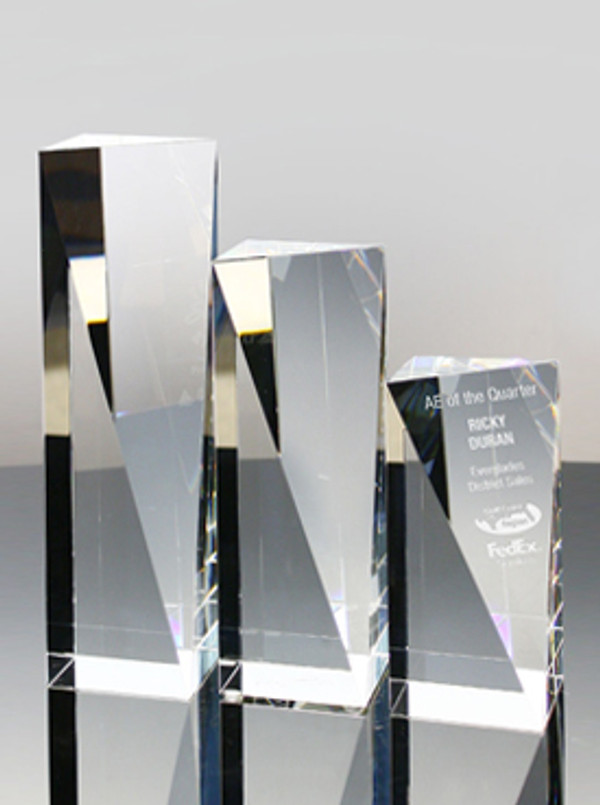
Search our engraved crystal award options by price, shape, or color.
Crystal Awards are very popular for many award categories in businesses and organizations including: Work Anniversary Gifts or Years of Service Recognition, Retirement Awards and Gifts, Performance Awards to honor individuals or groups who achieve or exceed their goals such as a sales quota, target margin, and profitability. We are often engraving crystal Appreciation Awards, Employee of the Month or Year to reward excellent attendance, customer service, growth, improvement, leadership and innovation. Not to mention trophies for competitions, tournaments and races, and so many more! All awards start blank and are personalized with your award information. If you have any questions, don't hesitate to call (800-753-3384) or Live Chat, if you need assistance with your search.
Q&A: Corporate Optical Crystal Awards
- What is the technical difference between Optical Crystal and traditional Lead Crystal in the context of corporate awards?
Optical Crystal is 100% lead-free and manufactured using extreme pressure, resulting in a perfectly clear, hard-surface material ideal for precision sandblasting and 3D subsurface engraving. Traditional Lead Crystal contains at least 24% lead oxide, making it softer and heavier, which allows for the deep-cut decorative facets often seen in traditional bowls or vases. For modern corporate awards, Optical Crystal is preferred for its flawless clarity and superior ability to refract light without the "green tint" found in common glass.
- Why is sandblast etching considered the gold standard for crystal engraving compared to standard laser engraving?
Sandblasting (or deep-etching) is a manual process utilizing a high-pressure stream of abrasive material through a photo-etched stencil to create a deep, smooth, and crisp white mark with a distinct tactile dimension. In contrast, standard laser engraving can sometimes leave a "fractured" or jagged appearance on the surface of the crystal. Sandblasting provides a much more elegant, permanent finish that conveys a higher level of craftsmanship and attention to detail.
- How can I identify high-quality crystal used in an award?
High-quality optical crystal should be free of bubbles, flow lines, and imperfections. When held up to natural light, it should not have a yellow or green hue, which is a hallmark of cheaper soda-lime glass. Quality crystal is also significantly heavier than standard glass and features sharp, hand-polished facets that catch the light.
- Can corporate brand colors be accurately integrated into a crystal award without compromising its style?
Yes, modern UV printing allows for high-resolution, full-color gradients to be applied to the back of the award. This technique creates a "floating" color effect that integrates branding while maintaining the sophisticated transparency of the crystal.
- What are the best practices for cleaning and long-term maintenance of optical crystal to ensure it remains a pristine legacy item?
Optical crystal is non-porous and highly resistant to yellowing, but it can collect fingerprints and dust. To maintain brilliance, use a soft, lint-free microfiber cloth and an ammonia-free glass cleaner. Avoid abrasive scrubbers or harsh chemicals that can scratch the surface. For deep-etched areas that have collected dust, a soft-bristled toothbrush can be used to gently clean the crevices without damaging the engraving.
- How does the weight and "hand-feel" of a crystal award contribute to the psychological impact of the recognition ceremony?
In psychology, the "weight-value association" suggests that heavier objects are perceived as having more importance and "gravitas". Presenting a substantial, heavy crystal award provides a tactile confirmation of the recipient's significance to the organization. A lightweight award can feel transient, whereas a weighty optical crystal piece feels permanent and consequential, reinforcing the recipient's sense of accomplishment during the presentation.
- Are there specific crystal shapes or designs that are better suited for vertical vs. horizontal corporate logos?
Vertical logos or "stacked" branding elements work best on Obelisks, Towers, and Pillars, which provide the necessary height for proper scaling. Horizontal logos or long company names are better suited for Crystal Wedges, Tablets, or "Iceberg" shapes. Choosing a shape that complements the logo's "natural footprint" ensures the engraving is as large and legible as possible while maintaining a professional, balanced aesthetic.
There are no products listed under this category.